
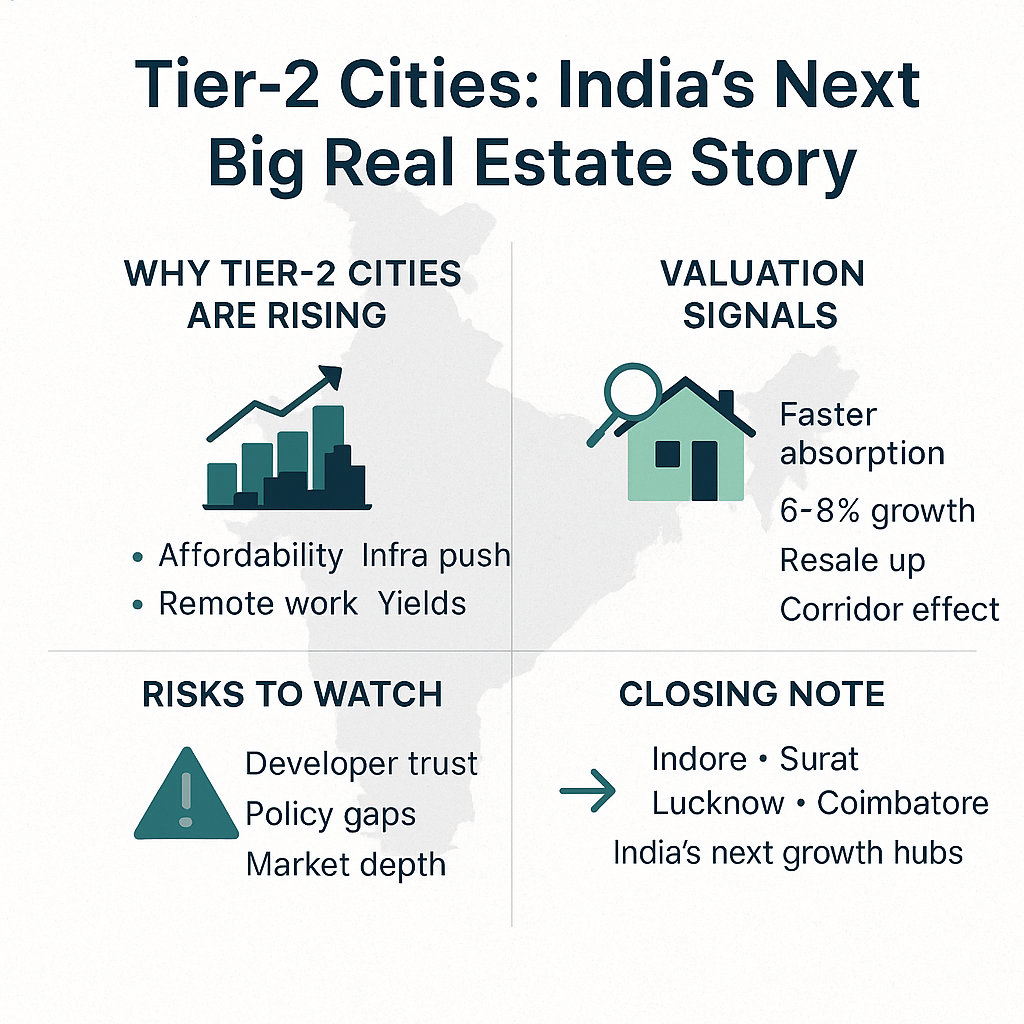
Tier-2 Cities: India’s Next Big Real Estate Story
Introduction
For years, property headlines in India were dominated by metros like Mumbai, Bengaluru, Delhi, and Chennai. But a quieter revolution is underway: the rise of Tier-2 cities.
Places such as Indore, Surat, Lucknow, and Coimbatore are no longer seen as mere “affordable alternatives.” They’re fast emerging as growth hubs and some of the most promising property investment destinations in India.
Why Tier-2 Cities Are Rising
-
Affordability: Homes are 30–50% cheaper than metros, attracting middle-class buyers and investors.
-
Infrastructure push: New airports, metro lines, smart city projects, and highways are fueling demand in cities like Surat and Indore.
-
Changing work culture: Hybrid and remote work allow professionals to live outside metros without losing opportunities.
-
Better yields: Investors are drawn to 3–5% rental yields and lower entry costs compared to Tier-1 cities.
What Valuation Data Reveals
-
Faster absorption: Properties in Tier-2 markets now sell within 6–9 months of launch, much faster than before.
-
Steady price growth: Average annual growth of 6–8% — not speculative spikes, but sustainable appreciation.
-
Resale market improving: Higher transaction volumes are making these markets more liquid.
-
Corridor effect: Properties near new highways, industrial hubs, and IT corridors are seeing the fastest appreciation.
Risks to Watch
-
Developer credibility: Smaller developers in Tier-2 cities may lack the brand trust of metro builders.
-
Policy variations: Regulation and compliance differ by state, affecting buyer confidence.
-
Market depth: While improving, resale activity in many Tier-2 cities still trails behind metros.
Closing Thought
The valuation signals are clear: Tier-2 real estate in India is entering its prime.
With affordability, infrastructure growth, and improving data transparency, cities like Indore and Surat are shaping up to be the next big growth story.
For lenders, investors, and developers, overlooking these emerging markets may mean missing the biggest real estate opportunity of the coming decade.